Token Garden: where your AI tokens go
A local, dependency-free dashboard for Claude Code, Codex, and OpenCode usage and cost, with a crew of garden gnomes.
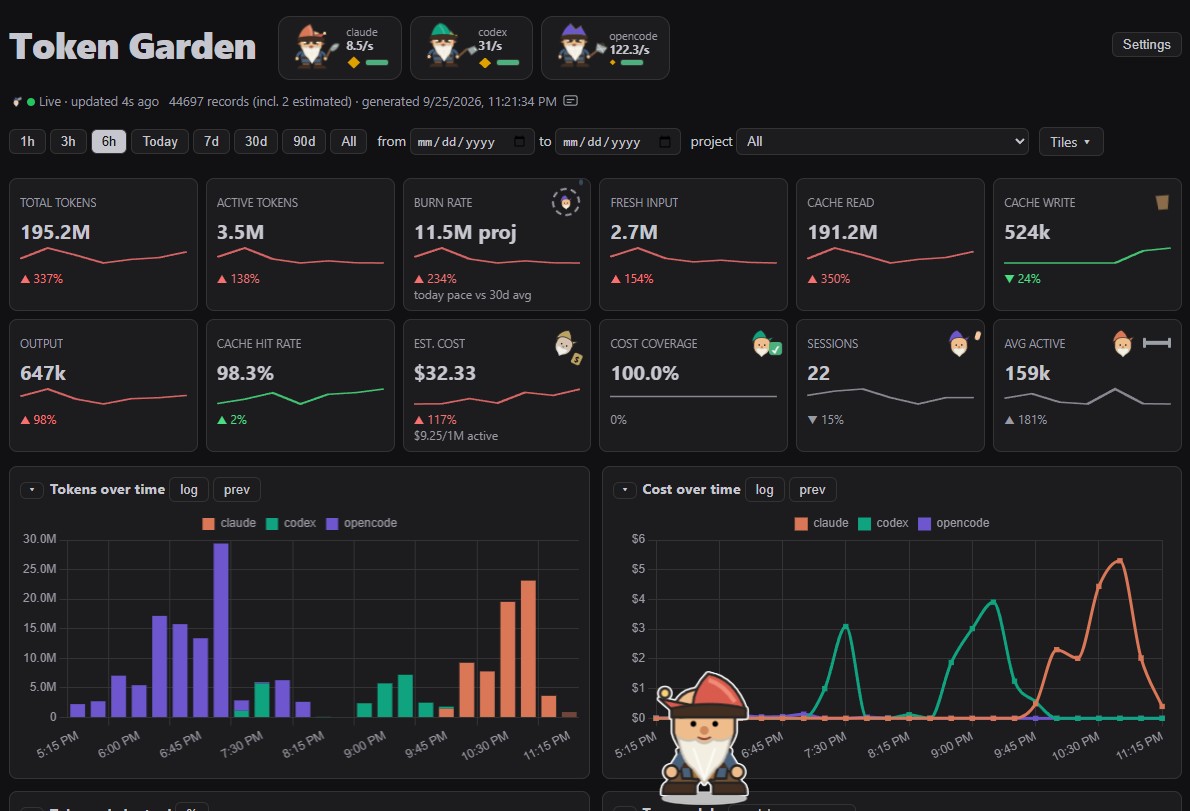
Coding agents spend tokens quickly, and the numbers live in log files nobody reads. Token Garden reads the local session logs from Claude Code, Codex, and OpenCode and turns them into one dashboard: tokens over time, estimated cost, cache hit rate, the most expensive sessions, and when in the week the work actually happens.
Nothing leaves your machine
Session logs contain prompts, file paths, and project names, so the dashboard is deliberately local. It is a small Node.js server bound to127.0.0.1, reading logs read-only. It rejects requests from other websites, and its content security policy stops page scripts from sending data anywhere else. The only outbound request is an hourly download of public model prices, which can be switched off.
No dependencies
There is no npm install and no build step. Clone it, runnpm run usage:serve with Node.js 22 or newer, and open the local URL. The first run parses every session log; after that a per-file cache means a restart takes about a second and only changed files are re-read.
Counting honestly
Most of the token volume in agent work is cache reads, which cost a fraction of fresh input. A single "total tokens" number hides that, so Token Garden also shows active tokens — fresh input plus output — alongside cache hit rate and cost coverage. Costs for Claude and Codex are estimates from public price tables and are labelled as such; OpenCode records its own.
The gnomes
The quirky part is on purpose. A crew of garden gnomes, one per tool, swing their tools faster as tokens flow and fall asleep when a tool goes idle. Smaller characters run the tiles: a hamster wheel for burn rate, an accountant stamping cost coverage, a weightlifter whose barbell grows with session size. A gnome wanders the page. All of it respects reduced-motion settings.
Crews are plain script files with a documented contract, so you can ask your own coding agent to draw a new one and keep it private.
Built to be extended by AI
The repository is small and written to be read by coding agents as much as by people. It includes an agent guide, a harness adapter guide for adding tools such as Cursor, and a crew guide. The README's starting prompt is short:
Clone
https://github.com/arturochang/token-garden, readREADME.mdandAGENTS.md, verify Node.js 22+, then start Token Garden withnpm run usage:serveand tell me the local URL.
Token Garden is free and MIT licensed. Like everything in LAB256's tools section, it comes without support or a roadmap.